Over the past few weeks, I have covered some wide-ranging topics.
International issues aside, any domestic issues that I've discussed, and
especially the ones I will cover in the ensuing weeks, will rightfully require
an examination of the issue of Federalism.
For those of you who are unfamiliar, or just did not pay attention in your
high school Civics class, let’s do a review of what Federalism is, and then how
it impacts the decisions our elected leaders make.
Federalism is a political concept
used to describe a system of government in which sovereignty is
constitutionally divided between a central governing authority and constituent
political units (such as states or provinces). Federalism is a system based upon
democratic rules and institutions in which the power to govern is shared
between national and provincial/state governments, creating what is often
called a federation. The "federation" in our country is more implicit
than direct, we are the "United States" not the American Federation.
Federalism in the US is the evolving relationship between state governments and
the federal government. Since the founding of the country, power shifted away
from the states and towards the national government.
The issue of federalism is one with roots as deep as
our country itself. It was the most important issue arising out of discontent
with the Articles of Confederation, which focused on limiting the authority of
the federal government. For example, the Articles allowed the Continental
Congress the power to sign treaties or declare war, but it was essentially
powerless to do so because all major decisions required a unanimous vote.
Discontent about this issue was greatly strengthened by the reaction to Shays'
Rebellion of 1786–1787, which was an armed uprising of farmers in western
Massachusetts. The rebellion was fueled by a poor economy that was created, in
part, by the inability of the federal government to deal effectively with the
debt from the American Revolution. Moreover, the federal government had proven
incapable of raising an army to quell the rebellion, so that Massachusetts had
been forced to raise its own.
The Federalists were a group of founding fathers who saw the weaknesses of
the present system, and recognized the need for a stronger central government,
even with the possible threat and recent memory of a strong centralized
government. They were the motivation behind the Constitution as agreed by the
Convention in Philadelphia. Those opposed to the new Constitution became known
as the "Anti-Federalists". They generally were local rather than
cosmopolitan in perspective, oriented to plantations and farms rather than
commerce or finance, and wanted strong state governments and a weak national
government. The Anti-Federalist critique soon centered on the absence of a Bill
of Rights, assuring basic freedoms from the stronger national Government. The
Federalists promised to, and did, provide in the first Congress.
With the ratification of the Constitution, the Federalist movement dissipated.
However, a new one; this time a political party based on the policies of
Alexander Hamilton for a stronger national government, a loose construction of
the Constitution, and a mercantile (rather than agricultural) economy; sprang
up. These groups were distinct entities, The Democratic-Republican Party, the
opposition to the Federalist Party, emphasized the fear that a strong national
government was a threat to the liberties of the people. Although they were two
different groups, nearly all members of the Federalist movement became members
of the Federalist party and nearly all of the opponents of the Federalist
movement became Democratic-Republicans, opponents of the Federalist Party.
Whatever division of federalism originally existed, it soon began the long
trek towards a strong national government. The United States Supreme Court,
under Chief Justice John Marshall, set about defining the dividing lines
between the layers of federalism that had not been specifically defined in the
Constitution. The Supreme Court settled the issues in McCulloch v. Maryland
and Gibbons v. Ogden, which broadly expanded the power of the national
government. Although later Courts would stress the limit of the national
government to the enumerated powers, both the sixteenth and the seventeenth
amendment bolstered the power of the national government, and divided state and
federal power. This period became known for Dual Federalism; that is, each sovereign
entity had certain roles that it took without interference of the other. (A
great, descriptive definition and comparison to later types of Federalism can
be found here.)
The issue of Federalism was not resolved, however, and remained so entwined with
our nation that it took an estimated 700,000 lives to settle it. I’m talking of
course about the Civil War. Though much hay is made about the slavery issue,
that was merely one stick in a bundle of state’s rights issues that had arisen,
including National Banks, taxes, tariffs, and Westward expansion. After the
civil war, the issue of federalism has reappeared from time to time, although
not with the drastic consequences. The war directly and succinctly brought the
issue of states’ rights to a head and the discussion was settled on the
battlefield; States’ rights must yield to national wishes. However, those sentiments
would not go away quickly. The end of Reconstruction exacerbated the situation,
and even today, the remnants of those problems remain.
Sixty years later, the Great Depression renewed the state’s rights feelings
as the Federal government began instituting control over the states in the name
of national economic strength. It marked an abrupt end to Dual Federalism and a
dramatic shift to a strong national government. President Franklin D. Roosevelt's
New Deal policies reached into the lives of U.S. citizens like no other federal
measure had. A policy of Cooperative Federalism began developing. The national
government was forced to cooperate with all levels of government to implement
the New Deal policies. In cooperative federalism, federal funds are distributed
through grants in aid or categorical grants which gave the federal government
more control over the use of the money. This continued throughout most of the
century, and from a states’ rights advocate’s perspective, the negative
consequences continued. In the 1960s, the Supreme Court firmly established that
the state must bend to the will of the national government through a series of
controversial decisions.
Another movement calling itself "New Federalism" appeared in the
late 20th century and early 21st century. In the 1980s, the Conservative
Revolution began preaching the states’ rights again, although history would
show that this claim was in name only. New Federalism, a gradual return of
power to the states, was initiated by President Ronald Reagan with his
"devolution revolution" in the early 1980s and lasted until 2001.
Previously, the federal government had granted money to the states
categorically, limiting the states to use this funding for specific programs.
Reagan's administration, however, introduced a practice of giving block grants,
freeing state governments to spend the money at their own discretion. Unlike
the states' rights movement of the mid-20th century which centered around the civil
rights movement, the modern federalist movement is concerned far more with
expansive interpretations of the Commerce Clause. President Clinton embraced
this philosophy, and President George W. Bush appeared to support it at the
time of his inauguration.
In 2001, the Federal government brought the largest use of federal power
against the states, what can be categorized as an unfunded mandated. That is,
they said ‘This is what we want done. Now do it on your own stretched budgets,
or else.” The problem is that the
federal government believes in cookie cutter solutions. It is clear that
solutions that work in New York City or Los Angeles may not be appropriate in
rural Iowa; and solutions that work in Minnesota may not be appropriate in
Mississippi. Government looks for the easiest solution, and this may not be and
is not the best solution for all places in all situations.
In the wake of the economic collapse of the Aughts, the Federal government
is not in the position to alleviate the need at the lower levels, thus, it can
be expected that a new round of states’ rights advocacy will spring up. That is
in fact exactly what we are seeing with States ignoring Federal mandates and
addressing marijuana, equal marriage, and other policies on their own terms. Further,
the federal government, in many ways, believes they are superior to states.
They believe they can create better solutions, the best solutions, and
obviously this is not always true. It’s impossible when you do not take into
account the ‘little’ factors- like socioeconomics, history, partisanism,
geographic considerations.
Recent government policy has taken both purposeful and inadvertent steps to
return power and authority to the states. However, they steps that have been
taken make the problem worse, not better. It is true that the federal
government is the better place for raising and allocating funds. However, the
decisions on how exactly to use those funds should rest with those who have a
better view of what is needed and better control to address problems: namely,
the states and local government.
Federalism is not a bad thing- but it must be used in the right way. It can
be a great way, if the system is changed, to allow local control with federal
guidance and funding, and improve the lives of individuals.
"Our nuclear strength is a reliable war deterrent and a guarantee to protect our sovereignty."
- Kim Jong-Un
North Korea, more correctly the
Democratic People’s Republic of Korea or DPRK, has once again come into the
news recently. Kim Jong-il, the “Dear Leader” of the DPRK died of a heart
attack on December 17, 2011. He, in the preceding years, had set his third son
Kim Jong-un as the clear successor to his position. The world has waited and
watched to see how the new Kim will lead his isolated nation. Even pop culture
world weighed in:
Now, under Kim Jong-Un, the 59 year
long armistice in Korea is over and the saber-rattling has reached the tipping
point. What is to come, and how did we get here?
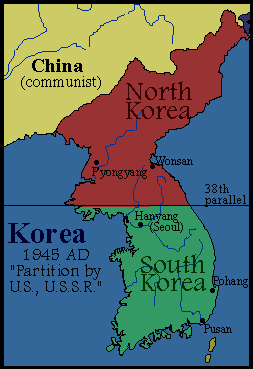
Korea is a 600-mile (966km)
peninsula jutting out from China and Russia. North Korea occupies the area, slightly
smaller than Pennsylvania, north of the 38th parallel. The country is almost
completely covered by a series of north-south mountain ranges separated by
narrow valleys. The Yalu River forms part of the northern border with China,
and a DMZ stretches roughly along the 38th parallel forming the
Southern border.
The ancient history of the Korean
peninsula can be traced to the Neolithic Age. The first agriculturally based
settlements appeared around 6000 B.C. Throughout its history, Korea has been
invaded, influenced, and fought over by its larger neighbors. Korea was alternatively a vassal state of China and Japan. When Western
powers focused "gunboat" diplomacy on Korea in the mid-19th century,
Korea's rulers adopted a closed-door policy, earning Korea the title of
"Hermit Kingdom." Chinese
influence dominated until the Sino-Japanese War of 1894–1895. Following Japan's
victory, Korea was granted “independence.” By 1910, Korea had been annexed by
Japan, which developed the country but never won over the Korean nationalists,
who continued to agitate for independence.
After Japan's surrender at the conclusion of World War II, the Korean
peninsula was partitioned into two occupation zones, divided at the 38th
parallel. This division was meant to be
temporary until the U.S., U.K., Soviet Union, and China could arrange a
trusteeship administration. The USSR controlled the north, with the U.S. taking
charge of the south. In December 1945, a conference convened in Moscow to discuss
the future of Korea. In September 1947, with no solution in sight, the United
States submitted the Korean question to the UN General Assembly. Initial hopes
for a unified, independent Korea quickly evaporated as the politics of the Cold
War developed. In 1948, the division was made permanent with the establishment
of the separate regimes of North and South Korea. The Democratic People's Republic
of Korea (North Korea) was established on May 1, 1948, with Kim Il Sung as
president.
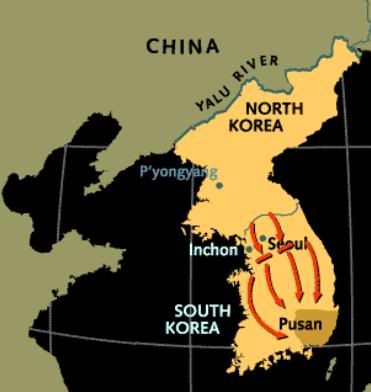
Hoping to unify the Koreas under a
single Communist government, the North launched a surprise invasion of South
Korea on June 25, 1950. In the following days, the UN Security Council
condemned the attack and demanded an immediate withdrawal. The United
Nations, in accordance with the terms of its Charter, engaged in its first
collective action and established the UN Command (UNC), to which 16 member
nations sent troops and assistance.Next
to South Korea, the United States contributed the largest contingent of forces
to this international effort.
The North Korean invaders swiftly
seized Seoul and surrounded the allied forces in the peninsula's southeast
corner near Pusan. In a desperate bid to reverse the military situation, UN
Commander Gen. Douglas MacArthur ordered an amphibious landing at Inchon on
Sept. 15 and routed the North Korean army. MacArthur's forces pushed north
across the 38th parallel, approaching the Yalu River.
Prompted by this successful
counteroffensive, Mao Tse-Tsung’s China entered the war, after large
numbers of Chinese "People's Volunteers" intervened to assist the
North, forcing the UN troops into a
headlong retreat. Seoul was lost again, but later regained. Ultimately, the war
stabilized near the 38th parallel in 1951 but dragged on for two years while
negotiations took place. An armistice was achieved on July 27, 1953.
On
that date, at Panmunjom, the military commanders of the North Korean People's
Army, the Chinese People's Volunteers, and the UNC signed an armistice
agreement. Neither the United States nor South Korea is a signatory to the
armistice per se, although both adhere to it through the UNC. No comprehensive
peace agreement has replaced the 1953 armistice pact; thus, a condition of
belligerency, or war, never ceased to exist. In 2013, the DPRK nullified the armistice
and war, in spirit but not form, has returned.
Relations between DPRK and ROK vacillate between warming and cooling.In 1971, 1984, 1986, and 1989; relations
warmed when North and South Korea held various talks whether through their
respective charity organizations or through the governments themselves. Talks
often revolve around joint activities (like hosting the 1988 Olympic Games),
trade, or reunification of families and even the countries. However, the talks
cooled when the ROK acted unilaterally (when they sought entry to the UN) or
the DPRK no longer wished to talk and acted against the ROK and the West (like
the 1987 bombing of KAL 858).
In September 1990, the first of eight prime minister-level meetings between
North Korean and South Korean officials took place in Seoul. The prime
ministerial talks resulted in two major agreements: the Agreement on
Reconciliation, Nonaggression, Exchanges, and Cooperation (the "Basic
Agreement") and the Declaration on the Denuclearization of the Korean
Peninsula (the "Joint Declaration").
The Basic Agreement, signed on December 13, 1991, called for reconciliation
and nonaggression and established four joint commissions. These commissions (on
reconciliation, military affairs, economic exchanges and cooperation, and social
and cultural exchange) were to work out the specifics for implementing the
basic agreement. Subcommittees to examine specific issues were created, and
liaison offices were established in Panmunjom, but in the fall of 1992 the
process came to a halt because of rising tension over North Korea's nuclear
program.
The Joint Declaration on denuclearization was signed on December 31, 1991.
It forbade both sides to test, manufacture, produce, receive, possess, store,
deploy, or use nuclear weapons and forbade the possession of nuclear
reprocessing and uranium enrichment facilities. A procedure for inter-Korean
inspection was to be organized and a North-South Joint Nuclear Control
Commission (JNCC) was mandated to verify the denuclearization of the peninsula.
On January 30, 1992, the D.P.R.K. finally signed a nuclear safeguards
agreement with the IAEA, as it had pledged to do in 1985 when becoming party to
the nuclear Non-Proliferation Treaty. This safeguards agreement allowed IAEA
inspections to begin in June 1992. In March 1992, the JNCC was established in
accordance with the Joint Declaration, but subsequent meetings failed to reach
agreement on the main issue of establishing a bilateral inspection regime.
Kim Il Sung's death on July 8, 1994,
introduced a period of uncertainty, as his son, Kim Jong Il, assumed the mantle
of leadership. Kim Jong Il continued his father’s vacillation between open
talks and saber-rattling. Kim has regularly used threats and hostile acts to
try to wring aid from the international community, but it was difficult to
decipher how he expected to accomplish his aims, economic aid and a safeguard
against U.S. attack, through such brinkmanship.
In Jan. 2002, President Bush
described North Korea as part of an “axis of evil.” Such open hostility marked
a dramatic shift in U.S. policy toward North Korea from the Clinton
administration's policy of engagement. Meetings between officials from the
U.S., North Korea, China, Russia, South Korea, and Japan in 2003, 2004, and
2005 ended in deadlock.
In July 2006, North Korea launched
seven missiles: the long-range Taepodong-2 missile (which failed) and six
medium-range weapons. It was North Korea's first major weapons test in eight
years. North Korea again sparked international outrage in October, when it
tested a nuclear weapon. President Bush called the test a “threat to
international peace and security” and called for sanctions against North Korea.
For the first time in 56 years,
trains passed between North and South Korea in May 2007. While the event was
mostly symbolic, it was, at the time, considered an important step toward
reconciliation. In Oct. 2007, Kim Jong Il and South Korean president Roh Moo
Hyun met for their second ever inter-Korean summit. The leaders forged a deal
to work together on several economic projects and agreed to move toward signing
a treaty that would formally end the Korean War.
Two more weapons tests followed: an
underground nuclear test and a short-range missile test. The nuclear test was
North Korea's second. International monitoring organizations said that it was
more powerful than the previous blast, three years ago.
In March 2010, the South Korean
warship Cheonan was sunk in an area of the Yellow Sea that's in dispute with
North Korea. Forty-six sailors were killed. Conditions further deteriorated in
November when North Korea attacked Yeonpyeong, a small island in South Korea
located near the maritime border between the North and South, killing two
soldiers and two civilians and leveling entire neighborhoods. Many speculated
that North Korea's provocative actions were intended to boost the credibility
and prominence of Kim Jong-Un, Kim Jong-Il's likely successor.
At the Korean Workers Party
conference in September 2010, President Kim promoted his third son, Kim Jong-Un,
to the rank of four-star general, gave him a seat on the party's Central
Committee, and appointed him as vice chairman the party's military commission,
paving the way for him to take over as president. Little is known about Un, who
is in his late 20s, other than he attended a private boarding school in
Switzerland.
Kim Jong-Il died of a heart attack
on December 17, 2011. The "Dear Leader" had been in power since 1994
and presided over his isolated country through a devastating flood that claimed
between 2 million and 3 million citizens in the 1990s and left the economy in
shambles. He taunted the U.S. and the international community with his dogged
pursuit of nuclear weapons. Kim Jong-Un succeeded his father and was given the
title "Great Successor." Kim's death and Kim Jong-Un's ascendance put
the world on high alert as a power struggle or an attempt by Kim Jong-Un to
prove his mettle could create a dangerous situation in an already unstable
country that has long harbored nuclear ambitions.
There was a sense of relief, as well
as caution, in late February when North Korea announced it was suspending
uranium enrichment at its processing facility in Yongbyon and halting tests of
weapons and long-range missiles. In exchange, the U.S. said it would resume
food aid to the impoverished nation. Observers speculated that Kim Jong-Un
might be attempting to win the favor of North Koreans with the infusion of food
or beginning to chart a new path in foreign relations. Nevertheless, North
Korea has made such promises in the past only to later renege.
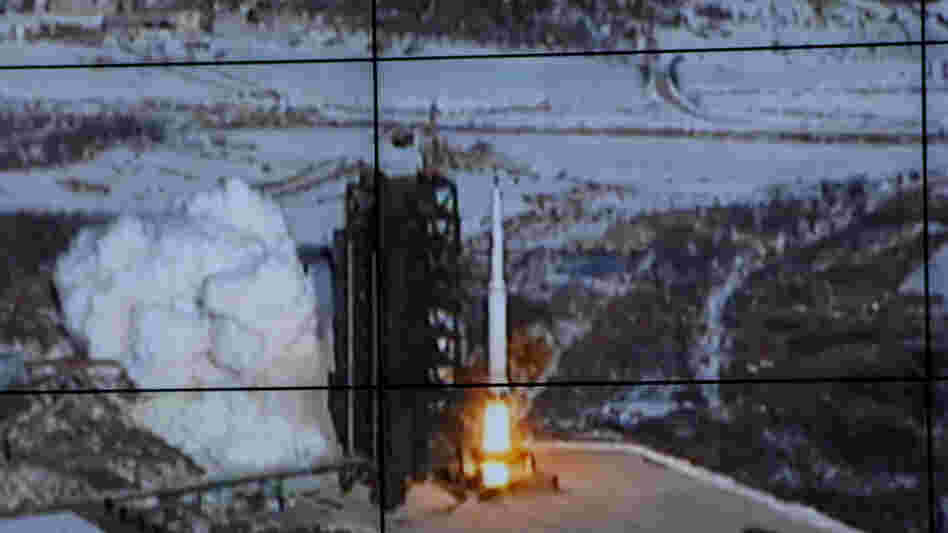
On April 12, the country attempted
to launch a rocket carrying a satellite into orbit, but the rocket blew up
seconds after the launch. The failure was an embarrassment to Kim Jong-Un, who
had just been honored with two new titles: leader of the national defense
commission, the nation's most powerful government agency; and first secretary
of the Workers' Party of Korea. The launch coincided with the celebration of
the 100th birthday of North Korea's founder and Kim Jong-un's grandfather, Kim
Il-sung. In response to the attempt, the U.S. suspended 240,000 tons of food
aid to North Korea.
North Korea's next attempt to put a
satellite into orbit was not a failure. The successful launch of the rocket on
December 12 indicated that the country was inching closer toward developing the
expertise to build an intercontinental ballistic missile. It also boosted Kim
Jong-un's credibility both domestically and internationally, illustrating his
seriousness in advancing the country's military capabilities. The launch took
the world by surprise and was followed by another round of UN sanctions that
were supported by China, which normally opposes such measures. Less than a week
later, astronomers reported that the satellite was spinning in orbit, a sign
that it had failed post-launch.
In Feb. 2013, North Korea said it
had detonated a third nuclear bomb. World leaders, scientists, and intelligence
officials rushed to determine if the bomb was fueled by uranium or plutonium.
Plutonium was used in earlier tests in 2006 and 2009, and officials said if
uranium powered the bomb then it was a signal that North Korea was on its way
to developing a larger and more powerful arsenal. The explosion was small
compared to those detonated by China in the 1960s and the U.S. in 1945 but
larger than North Korea's previous tests. In response to the test, the UN
Security Council unanimously passed another round of strict sanctions against
North Korea. In a first, China was involved in drafting the sanctions. The
sanctions came shortly after the U.S. and South Korea began annual military
drills near the north-south border. Reacting to the sanctions and the
exercises, President Kim promised to launch “a pre-emptive nuclear strike”
against the U.S. and South Korea and said he had voided the 1953 armistice that
ended the war between North and South Korea. Kim's threats were mostly dismissed
as bluster but were nevertheless the most menacing in years by any leader. He
continued his bellicose tone in March and shut down not only Red Cross hotlines
between North and South Korea but also military hotlines. At a rare plenary
meeting of the Central Committee, Kim said North Korea would continue to
develop its nuclear weapons program despite sanctions, saying the weapons
"“are neither a political bargaining chip nor a thing for economic
dealings."
In March, the US responded to the
growing threat from North Korea by continuing the military drills with South
Korea, deploying F-22 stealth fighter jets and B-2 and B-52 bombers to the
region in a show of its military strength. The U.S. also increased the number
of ground-based ballistic missile interceptors in California and Alaska.
The question then stands, what is to
happen now?
I think it would be impossible for
anyone to predict the behavior of any leader of North Korea. Although the
leadership basks in relative wealth and has travelled beyond its borders (Un was
educated in Switzerland), it has been the nation’s policy to be unpredictable.
Un’s grandfather Kim Il-Sung fluctuated between Soviet and Chinese spheres,
playing each against the other for his own benefit. Kim Jong-Il made the same
policy, now bouncing between an active member of the international community
and being an isolated, unknown entity. It seems that Kim Jong-Un has learned
those lessons of his father and repeated them.
Reports from the DPRK read straight
out of 1984. The government rewrites history as it sees fit and the people,
victims of the leading family’s personality cult, follow in lock step. Any divisiveness
is met with purges. Millions gather to disparage the West and raise up the
Great Successor as a demigod.
I have
previously mentioned a personal conversation that I had with former UN weapons
inspector Scott Ritter. In that conversation, he stressed that North Korea was
far greater a threat than Iraq. The DPRK is a known WMD proliferator, or was
under Jong-Il, and their military development is the number one priority. In
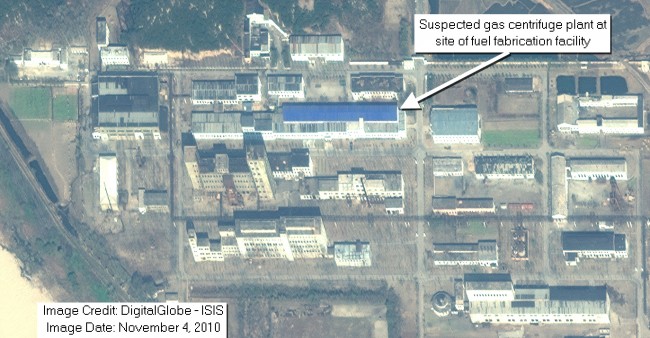
2010, Siegfried
Hecker, a Stanford professor and former director of the Los Alamos National
Laboratory, said that during a visit to North Korea, officials gave him a tour
of a uranium-enrichment facility that contained 2,000 centrifuges that can be
converted to produce nuclear weapons. Hecker described the facility as
sophisticated and "ultra modern."
But let’s separate fact from fiction. Question
number one: does the DPRK have nuclear weapons? My study of the subject
suggests that this is a fact. Although their first weapon, likely a plutonium
bomb, was small and relatively unsuccessful; it has been theorized that the
more recent bombs were uranium, had higher yields, and, although less powerful
than Hiroshima, is still a powerful weapon. The important thing to keep in
mind, when it comes to using these weapons, is size. Below are two pictures.
The first is a picture of the Trinity Test device, America’s first nuclear
weapon. The second is a picture of “Fat Man,” one of the United State’s first
atomic weapons. The scale is important here. These weapons are much larger than
a man and exponentially heavier. The DPRK has no ability to deliver a weapon of
this type, as they possess few, if any, heavy bombers and their rockets don’t
have the payload capacity.
Question number two: Can the DPRK attack the US?
This is where the issue gets cloudy. It is clear that North Korean rocket
technology has greatly advanced. Their short, medium, and intermediate range
rockets have had multiple successive tests, but it’s unclear whether their
targeting programs would allow for accurate use of the weapons. Typically, they
program the weapons to splash down in the Pacific. In any event, their rockets
could reach South Korea, Japan, Taiwan, the Philippines, and other US allies in
East and Southeast Asia, and the Pacific. They could also attach US forces,
including permanent bases, in these countries. Arguably, the medium range
rockets may even be able to reach Guam or other US Pacific territories, and
maybe even the Hawaiian Islands. However, reports from their long range rocket
tests have been less successful. They have had multiple failures and even later
examination of the “success” of launching a satellite shows trajectory problems
in the crucial third stage. The likelihood that they now possess accurate ICBM
technology is slim to none. Assuming they could even reach the continental US,
its unlikely that the targeting would be accurate, and they certainly could not
carry the payload of their current WMD size. (Much like other technology,
nuclear weapons can get smaller and lighter as the program progresses in
success.)
Question number three: Would the US go to war in South
Korea if North Korea doesn’t attack us? The short answer is yes. The Mutual Defense Treaty Between the United States and the Republic of
Korea, which was signed October 1, 1953 and later ratified by both countries
states, in pertinent part, ARTICLE III, Each Party recognizes that an armed attack in the Pacific
area on either of the Parties in territories now under their respective
administrative control, or hereafter recognized by one of the Parties as
lawfully brought under the administrative control of the other, would be
dangerous to its own peace and safety and declares that it would act to meet
the common danger in accordance with its constitutional processes. Further, it
states,ARTICLE IV, The Republic of Korea grants, and the United States of
America accepts, the right to dispose United States land, air and sea forces in
and about the territory of the Republic of Korea as determined by mutual
agreement. (Read the entire agreement here.) Basically,
the United States has agreed to come to the aid of South Korea is unjustly
attacked by any other force. The one caveat is the clause “in accordance with
its constitutional processes.” This means, for the US, Congress would have to
approve of the use of force. See my previous post on Iraq to how difficult that
may be.
Question
number four: Would the DPRK be able to continue a war against the US and
allies? This is another tricky question. Technically, the DPRK has the fourth
largest armed forces in the world. However, a lesson can be shown by the
previous fourth largest military: Iraq. Although North Korea has a large army, in
terms of soldiers and machines, the majority of their troops are likely to be
malnourished. When compared, they would not be on par with the average American
soldier. They are using a mixture of technology from WWII through, possibly,
even modern weaponry. They do have something that perhaps Iraq did not. They
were raised in the juche and personality cult of North Korea. The military of
Iraq was a mixture of ethnicities and religions. The DPRK armed forces are
homogenous in ethnicity and religion. They are likely to fight to the death for
the Great Successor. You must imagine their forces to be, in passion, far more
like those of the Japanese Empire than any other previous enemy of the US. While
the US, and allies, were able to roll through the Iraq military, and take
thousands of willing prisoners along the way; there would likely be far fewer
prisoners and more bloodshed to make progress. Moreover, in the scenario where
the DPRK is the aggressor, the US would have no staging ground as they did in
Kuwait and Saudi Arabia before the Iraq invasion. It would be necessary to
throw any available troops into the fight, almost haphazardly. Under the worst of
circumstances, an amphibious and air assault may be necessary to liberate South
Korea.
I would be
happy to answer any other questions people have, please just post in the
comments below. To summarize, here are my thoughts. It is almost North Korean
policy to “rattle their sabers.” Like a petulant child, the leaders of the DPRK
think that the only way to get attention and respect is to intimate their
impressive military and nuclear capability should be feared. In the coming
months, I will post about the dangers of our current nuclear policy and how it
encourages proliferation, rather than limiting it. However, I don’t think that
there should be any big concern about an attack from North Korea on either US
or South Korean forces. North Korea gains nothing from such an action, and
risks complete annihilation. However, they can gain something from making threats
and then backing off. Kim Jong-Un is a new leaders, and he needs to consolidate
power in the face of continuing food shortages and overall poverty. This is the
way he has chosen to do it. Express strength, make threats, and hope to bring
everyone else to the table; only to do it again later.
I must stress that North Korea remains a
potent force and pre-emptive action is not only unnecessary, but looking to
history, would be more detrimental than good. Hopefully, our leaders have
learned that lesson and will use restraint with DPRK threats. However, we must
also be wary of rewarding bad behavior and using appeasement to diffuse
conflict. History also shows that this does more harm than good. It is
certainly a tight line to walk, and hopefully the US and UN will do so.
“If
the circumstances were otherwise, I should veto the bill. Even so, I
cannot permit this legislation to become effective without
registering my protest against the attachment to this bill of an
irrelevant and unwarranted rider… This system of attaching riders
to bills relating to a wholly different subject has been used by
former Congresses in a number of notable cases. Such abuses of sound
legislative procedure have been protested by many former Presidents,
and the practice has been condemned by sound opinion. It is
noteworthy that the Constitutions of many States require that a
proposed law shall relate to only one subject… All
that remains to me is to permit the act to become a law without my
signature. I am doing this with two earnest objections. The first is
against the practice of attaching extraneous riders to any bill.”
President
Franklin Delano Roosevelt, addressing The Public Debt Act of 1943
(which allowed national debt authorization to gear up for WWII)
On Tuesday,
President Obama signed the Consolidated and Further Appropriations
Act of 2013. There has been much political hay made about the
President slipping the Act in while the country and media were
distracted with the equality in marriage arguments before the Supreme
Court. However, this is not really the case. The opposition is not to
the bill as a whole, its to a rider attached to the bill known as the
Farmer
Assurance Provision, or known to the opposition as the Monsanto
Protection Act. The full text of the Provision is below:
13 SEC. 733. In the
event that a determination of non
14 regulated status
made pursuant to section 411 of the
15 Plant Protection
Act is or has been invalidated or vacated,
16 the Secretary of
Agriculture shall, notwithstanding any
17 other provision
of law, upon request by a farmer, grower,
18 farm operator, or
producer, immediately grant temporary
19 permit(s) or
temporary deregulation in part, subject to
20 necessary and
appropriate conditions consistent with sec-
21 tion 411(a) or
412(c) of the Plant Protection Act, which
22 interim
conditions shall authorize the movement, introduc-
23 tion, continued
cultivation, commercialization and other
24 specifically
enumerated activities and requirements, in-
25 cluding measures
designed to mitigate or minimize poten-
1 tial adverse
environmental effects, if any, relevant to the
2 Secretary’s
evaluation of the petition for non-regulated
3 status, while
ensuring that growers or other users are able
4 to move, plant,
cultivate, introduce into commerce and
5 carry out other
authorized activities in a timely manner:
6 Provided,
That all such conditions shall be applicable only
7 for the interim
period necessary for the Secretary to com-
8 plete any required
analyses or consultations related to the
9 petition for
non-regulated status: Provided further, That
10 nothing in this
section shall be construed as limiting the
11 Secretary s
authority under section 411, 412 and 414 of
12
the
Plant Protection Act.
First,
as always, lets cover a little background. In legislative procedure,
a
rider is
an additional provision added to a bill, often having little
connection with the subject matter of the bill. Riders are usually
created as a tactic to pass a controversial provision that would not
pass as its own bill. Occasionally, a controversial provision is
attached to a bill not to be passed itself but to prevent the bill
from being passed. I will be doing a post later about riders and
amendments, to go into greater detail. I think they are one of the
most dangerous risks to the future fiscal health of the country.
Riders
are most effective when attached to an important bill, such as an
appropriation bill, because to veto or postpone such a bill could
delay funding to governmental programs, causing serious problems.
When the veto is an all-or-nothing power as it is in the United
States Constitution, the executive must either accept the riders or
reject the entire bill. The practical consequence of the custom of
using riders is to constrain the veto power of the executive.
That
is what happened in this case. The
bill helped the government avoid a March 27 shutdown.
It was absolutely necessary, so it was a no lose scenario for the
Republicans. Once the rider was attached, either their corporate
sponsor got what they paid for (and by paid, I of course mean their
campaign contributions) or the President vetoed the bill and they
could blame him for a government shut down. Often overlooked, is the
fact that HR 933, the bill that Obama signed, was rushed through
Congress and onto his desk. Most, if not all, of the Congressmen who
voted for it didn't know about the provision. I would wager that not
one Congressman read the bill in its entirety. In fact, there was
almost no time to read the final version before the vote. With the
government shut-down approaching, the President had no real option.
To
counteract riders, 43 of the 50 states have provisions in their state
constitutions allowing the use of line-item vetoes so that the
executive can veto single objectionable items within a bill, without
affecting the main purpose or effectiveness of the bill. The Line
Item Veto Act of 1996 was passed to allow the President of the United
States to have the same authority that those state governors have.
However, the Supreme Court struck down the act as unconstitutional in
Clinton
v. City of New York.
Thus, President Obama had only the choice to veto the entire bill,
and shut down the government, or sign it with the rider attached. The
lesser of two evils, he chose to sign it.
Realistically,
there is no real long-term impact. The Provision will only remain in
effect for six months until the government finds another way to fund
its operations and can address the Sequestration. However, it sets a
terrible precedent. Corporations, already given too much power and
authority, and dubbed by some “too big to jail,” can get around
consumer safety protections if they get Congress on their side.
Furthermore, it makes the suggestions that court challenges are a
privilege, not a right. I will say that,
realistically and Constitutionally, Congress does not have the right
to limit the power of the judiciary. Judicial review is a check and
balance on the legislative. However, addressing it at all is a 'shot
across the bow' to the judiciary, to let them know their once
sacrosanct authority has limits.
In conclusion, I
guess my perspective is to say- Let's all calm down. Yes, this sets a
bad precedent. But realistically, there is no long term harm from
this bill. It will expire at the end of the fiscal year. And it's not
something that we shouldn't expect. Corporations have too much power.
They make large campaign contributions and can literally write
legislation to hand-off to elected officials. Our. System. Is.
Broken. I think you can take from the tone of this blog that I've
already reached that conclusion, I hope you will too. The one benefit
of the hoopla surrounding this legislation is that people are waking
up and seeing the system for what it is.